 Justin Bell | 10/19/2026
How Human Centered Design Principles Apply to Prompt Engineering
Prompt engineering: practice of carefully crafting instructions, or prompts, to guide generative AI models towards producing the desired output.
Human Centered Design: an approach, formalized in ISO 9241-210 and popularized by Don Norman in The Design of Everyday Things, that prioritizes understanding and meeting the needs of the users who will interact with a product, service, or system.
The core principles of Human Centered Design (HCD) focus on understanding how the target users process information and what their needs are. Designers utilize this information in empathizing with end users when crafting user experiences. As a result, this ensures the actions taken by those users lead to an outcome that satisfies the business case.
Similar methodologies can be applied in prompt engineering to understand how AI models process information. This knowledge is used to format the prompt, so the desired response is returned. As an emerging field of its own, the practice of prompt engineering is quickly formalizing. For example, this can be found in guides published by leaders in GenAI. Anthropic, Google, and OpenAI all offer resources for new practitioners.
Comparing Concepts
At their core, both disciplines are deeply concerned with understanding and effectively interacting with a “user” to achieve a desired outcome. Let’s break down how HCD concepts beautifully translate to the world of prompt engineering:
| 1. Understanding the “User” (The AI Model) | |
| HCD: In traditional UX, the first and most crucial step is to deeply understand the target user: their needs, goals, motivations, behaviors, and limitations. We employ user research methods like interviews, surveys, and usability testing to gain these insights. | Prompt Engineering: While we can’t conduct traditional user interviews with an AI model, we need to understand its capabilities, limitations, knowledge base, and how it interprets language. Capability probing and model documentation review become our “user research” methods. We learn how it responds to different phrasing, formats, and instructions. |
| 2. Defining the Goal (Desired Outcome) | |
| HCD: UX designers work to clearly define the user’s goals and the business objectives. What problem are we trying to solve? What task does the user want to accomplish? | Prompt Engineering: Effective prompt engineers start with a clear understanding of the desired output from the AI. What information are we seeking? What creative content do we want generated? What task do we want the AI to perform? A well-defined goal is the foundation of a good prompt. |
| 3. User-Friendly “Interface” (The Prompt) | |
| HCD: UX designers focus on creating intuitive and efficient interfaces that allow users to interact with a system easily. Clear navigation, understandable labels, and logical layouts are key. | Prompt Engineering: The prompt itself is the “interface” through which we interact with the AI. A well-crafted prompt is clear, concise, and provides the AI with the necessary context and instructions to understand our request effectively. Just like a poorly designed interface leads to user frustration, a poorly written prompt leads to unsatisfactory or irrelevant AI responses. Role prompting (providing a persona for the AI to assume), and structured output guidance are key elements that result in more successful responses. |
| 4. Context and Mental Models | |
| HCD: UX design considers the user’s existing knowledge, expectations, and mental models. We design interfaces that align with these mental models to make the system feel familiar and easy to use. | Prompt Engineering: Providing sufficient context in a prompt is vital. We need to consider the AI’s “mental model” (how it has been trained and how it understands information). Providing relevant background information, specifying the desired format, and clarifying any ambiguities helps the AI understand our request within the appropriate context. |
| 5. Error Handling and Feedback | |
| HCD: Good UX design anticipates potential errors and provides clear and helpful feedback to users when things go wrong, guiding them toward a solution. | Prompt Engineering: When an AI provides an unsatisfactory response, it’s a form of “error.” Analyzing this response helps us understand what went wrong with the prompt. We then refine the prompt to avoid similar issues in the future. The AI’s output, whether good or bad, serves as feedback that informs our next iteration of the prompt. Beyond reactive refinement, experienced prompt engineers build error handling into the prompt itself using negative prompting (explicitly stating what you do not want) or output validation instructions (telling the AI to check its own answer). |
| 6. Iterative Design and Testing | |
| HCD: UX design is an iterative process. We create prototypes, test them with users, gather feedback, and refine our designs based on those insights. This cycle of design, testing, and iteration ensures we are building a user-friendly and effective product. | Prompt Engineering: Starting with an initial prompt, observe the AI’s response, analyze its strengths and weaknesses, and then refine the prompt. This iterative process of prompting, evaluating, and adjusting is crucial for achieving the desired output and uncovering what works best with a particular model. Think of it as “usability testing” for your prompts. Chain-of-thought prompting builds iteration directly into a request by asking the AI to reason through a request step by step allowing human intervention and adjustment. Similarly, prompt versioning can be used to transform the process from informal tinkering to a maintained design system with the ability to reference previous iterations. |
In essence, prompt engineering is the application of human-centered design principles to the interaction between humans and AI language models. Prompt chaining — breaking a complex task into a sequence of smaller, targeted prompts where each output feeds the next — is perhaps the most complete expression of HCD applied to AI. It mirrors the UX principle of progressive disclosure. Rather than overwhelming a user (or a model) with everything at once, you design a sequence of focused interactions. These then build toward a complete outcome. This is also the architectural foundation of the agentic systems Analytica builds. In these systems, each agent in a pipeline is effectively a purpose-designed interface optimized for one specific interaction.
Human-machine relations
IDEO’s design thinking cycle (empathize, define, ideate, prototype, test) maps almost exactly onto the prompt engineering workflow. The discipline is the same; only the medium has changed. By understanding the “user” (the AI), defining clear goals, iterating on our “interface” (the prompt), providing context, and learning from “errors” (undesirable outputs), we can engineer prompts that effectively guide AI models to generate valuable and relevant results.
 It’s worth being honest about where the analogy runs out. In traditional HCD, the user is a person; someone you can interview, observe, and learn from directly. An AI model can’t tell you it’s confused, advocate for what it needs, or remember yesterday’s conversation. The prompt engineer’s version of empathy is less like understanding a colleague and more like deeply knowing a material. A skilled carpenter doesn’t interview the wood, they learn how it responds through experience and experimentation. That’s a meaningful difference, but it doesn’t break the parallel. It just means the human side of the interaction must carry more interpretive weight than it would in traditional UX work.
Just like a skilled UX designer crafts intuitive user experiences, a skilled prompt engineer crafts effective prompts that unlock the full potential of AI language models. The underlying philosophy of understanding the user and designing for their needs remains the same. Just the “user” and the “interface” are different. By consciously applying these human-centered design concepts, we move beyond simply “talking” to the LLM. Instead, we engage in a more thoughtful and effective form of communication.
How We Apply this Concept
At Analytica we apply this methodology in training our team members, coaching clients on how to directly interact with AI chat interfaces, and as the foundation of Agentic design. Our architects and user experience designers collaborate to craft holistic solutions that present users with a UI designed to collect the critical information the AI agent requires to execute the intended operation to its fullest. We have combined this approach with the integration of orchestrator agents in multi-agent systems to increase accuracy of responses that satisfy the user’s needs with less query cycles required. 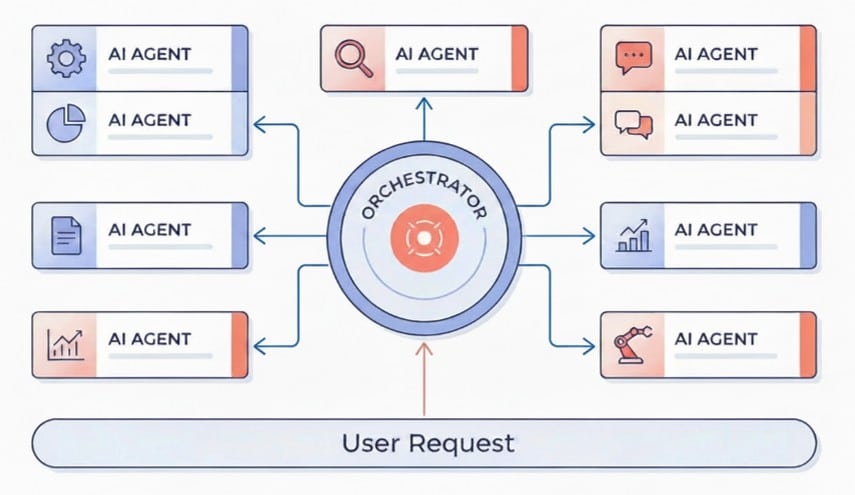 A traditional chat interface asks users to articulate their full requirements in a single open text field, the equivalent of handing someone a blank piece of paper and asking them to write a complete design brief. By replacing that with a structured intake UI that walks users through context, constraints, and desired output format as discrete inputs, we give the orchestrator agent a well-formed prompt to work from rather than an ambiguous one. The reduction in back-and-forth is a direct outcome of the prompt being more complete before the initial generation step, not after.
Another application of this methodology our teams have been working on is using natural language discussion prompts in collaboration with an orchestrator agent to establish the bounds and requirements that a coding agent must follow when performing AI assisted development. To do this, we must first understand how the coding agent processes the information a user provides. Next, we translate the intent of the natural language request from a user into a clear specification the agent can follow to know what it should and should not do. We rapidly iterate by reviewing the output of the agent and modifying the specification until all requirements are satisfied. This mirrors findings from research on structured prompting in code generation contexts. For example, studies evaluating models on benchmarks like HumanEval and SWE-bench consistently show that prompts with explicit constraints, typed signatures, and defined edge cases outperform open-ended requests by substantial margins, regardless of model. Moreover, our approach applies that same principle through a conversational front-end. This is rather than requiring developers to write formal specifications manually.
Contact us if you would like to learn more about the agentic AI work Analytica is doing or how we can partner to support your organization’s mission.