 Justin Bell | 7/25/2026
The missing layer between enterprise data and production-ready AI

Federal agencies have spent years building serious data infrastructure: warehouses, catalogs, pipelines, and governance frameworks. The investment is real. Yet AI pilots still return answers that are inconsistent, unreliable, or wrong.
The instinct is to blame the model: swap it out, fine-tune it, or try the newest one. But most of the time, the model is not the problem. The real issue is the data and context behind it.
Here is the uncomfortable truth: enterprise data, especially in government environments built over decades by different contractors and internal teams using different standards, often means very little on its own. A column called case_status in one system may mean something completely different in another. A metric called “active accounts” in finance may not match what compliance means by the same term. The data is there. The meaning often is not in a form an AI agent can use reliably.
This is the semantic vacuum, and it is a major reason AI adoption stalls at the enterprise level.
A Semantic Layer Helps, But It Is Not Enough
A semantic layer is a critical step forward. A good sematic layer normalizes your data and standardizes the terminology used for it across your organization in preparation for consumption. But if your goal is AI that works in production, it only gets you part of the way there.
If you do not have it, build it. Even a basic semantic layer, such as a business glossary, standardized metrics, or a BI foundation, can be transformative.
That matters. But for AI in production, it is still not enough.
| Semantic Layer | Context Layer |
|---|---|
| Defines what the data means | Defines how the data should be used |
| Standardizes metrics, dimensions, and business definitions | Adds operational, governance, and policy context |
| Supports consistent calculations and reporting | Supports safe, reliable agent behavior |
| Tells an agent what the data is | Tells an agent who is asking, why they are asking, what rules apply, and whether the data is fit to use |
The table makes the distinction clear: the semantic layer defines meaning, while the context layer enables trustworthy AI behavior in production. Unlike a context window, which is temporary and only meant to be applied to an individual session, context layers are persistent, scope to an entire environment and continuously adapt to mold agent behavior to the business need.
The Layer That Makes AI Work in Production
If a semantic layer defines meaning, the context layer is what turns that meaning into reliable action.
That includes things like:
- Governance rules: which roles can access which entities and what audit trails are required
- System health signals: whether a dataset is current and when it was last refreshed
- Usage patterns: how other analysts have used the data and what issues they encountered
- Business process context: what mission function the data supports and what decisions depend on it
- Cross-system relationships: how an entity in one system maps to the same concept in another
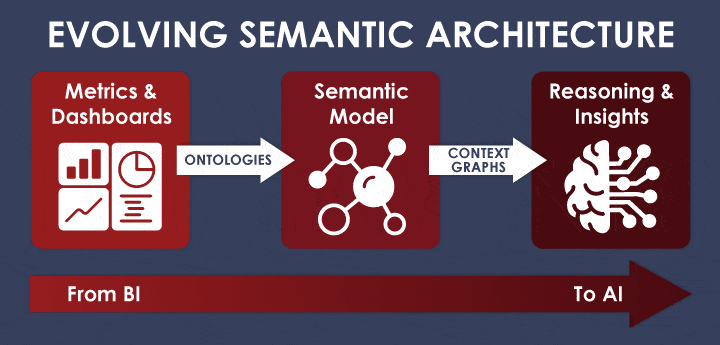
In practice, this works as a shared model of mission entities, terms, and relationships drawn from authoritative agency sources. It connects disparate data assets and acts as the hub in a hub-and-spoke model, linking data assets, agent tools, and query patterns back to the same governed definitions.
What makes this different from a traditional data model or knowledge management effort is how it gets built. In the past, constructing a structured framework that defines the concepts, properties, and relationships within a specific domain of knowledge (known as an ontology) meant years of manual work, with teams mapping systems to each other. Today, AI-assisted extraction can turn an agency’s process documentation, such as operations manuals, regulatory guidance, and standard operating procedures, into a working draft ontology in days. AI does the extraction, and humans validate the results.
Just as important, the context layer is not a replacement for governance, not a standalone AI model, not a one-time metadata exercise, and not a shortcut around security or policy reviews. It is the operating layer that helps agents use governed data safely, consistently, and in the right mission context.
What This Looks Like in the Real World
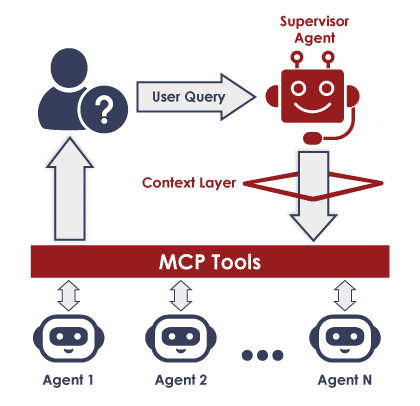 When you put this into practice, it does not look like one all-knowing agent. It looks like a coordinated system.
Analysts submit questions to a supervisor agent. Instead of answering from its own knowledge, the supervisor checks the context layer, identifies the question type, and routes it to the right specialist.
- Catalog agent: explains what datasets exist and how they relate
- Data product agent: finds the right data product for a given use case
- Query agent: translates business questions into governed queries using ontology definitions
- Knowledge agent: surfaces lessons from prior support interactions so analysts can avoid known pitfalls
The supervisor routes. The specialists act. The shared mission model keeps everything grounded in approved definitions and relationships.
This produces not just accurate answers but auditable ones. Every response traces back to a specific tool call, data asset, and ontology definition. In environments where data-driven decisions must be defensible, that traceability is what separates a demo from a production system.
The Step Most Teams Overcomplicate
This is where many teams make the work harder than it needs to be.
Organizations often assume that because their data environment is complex, with legacy systems, schema debt, and inconsistent terminology, the context layer must be a massive multi-year effort before it delivers value. It does not.
- Pick one mission domain with an engaged owner and solid documentation.
- Build the ontology.
- Map the relevant data assets.
- Deploy the agent architecture for that scope.
- Evaluate the results.
- Expand from there.
Each new domain makes the system stronger. The architecture stays the same. The ontology expands. The agents reach farther.
This is also where publicly available documentation becomes an underused asset. Most agencies publish process documentation that describes, in authoritative language, the business processes and entities an ontology needs to capture. With AI-assisted extraction, that material becomes a much faster starting point than many expect.
Why Production AI Raises the Stakes
As AI moves from demos to production, the bar gets much higher.
The organizations that get there first will invest in the infrastructure beneath the model: definitions, relationships, governance rules, and context. Not as a one-time project, but as a durable asset that grows more valuable as more AI activity runs through it.
The model is not the bottleneck. Context is. If you want AI that works in production, start building the context layer now.