 Timm McShane | 7/20/2026
Five Questions Federal Leaders Should Be Asking About AI (Not the Ones They’re Used To)
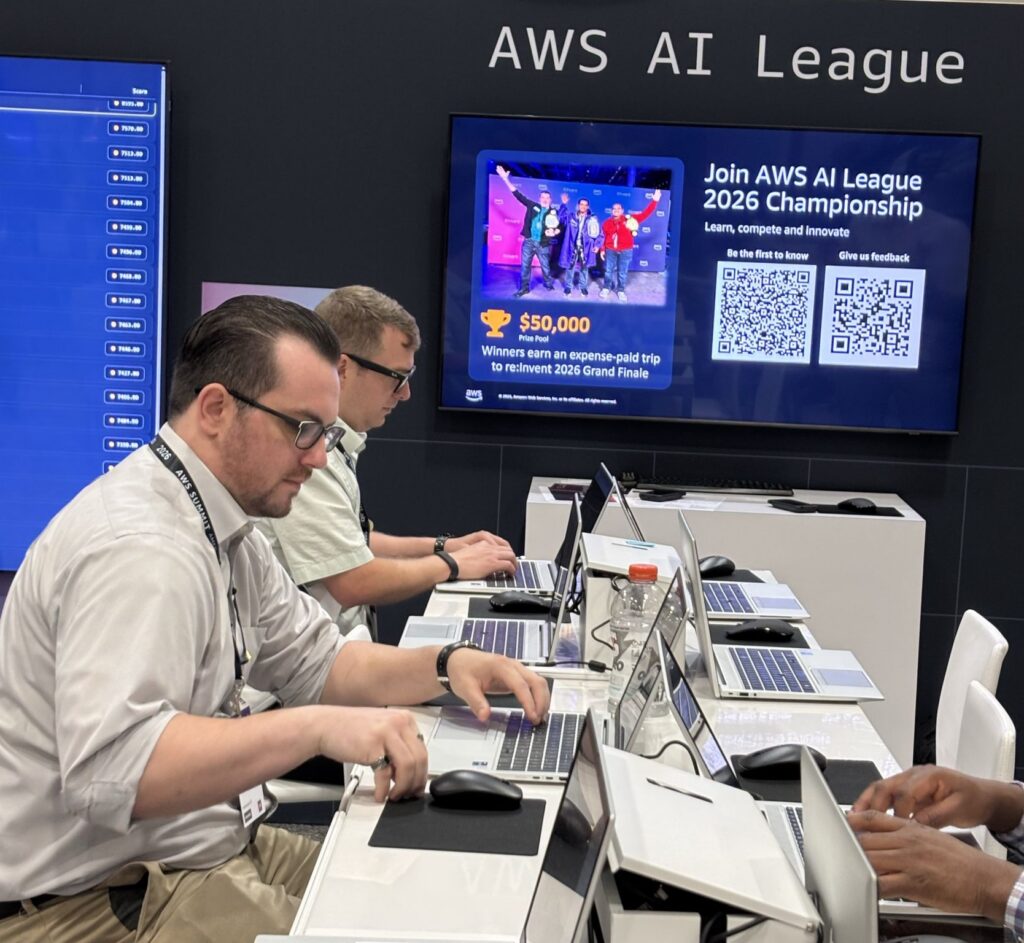
Analytica’s Data Science Practice Manager, Tony Kelly, placed 5th in the AI League Championship at AWS Summit 2026
AWS Summit 2026 made one thing clear: federal AI is graduating from pilot projects to production operating models. For agencies, ensuring production AI readiness is becoming critical. Across dozens of sessions on agents, developer tooling, security, and document automation, a single architecture kept resurfacing – a mission event triggers an agent, the agent draws on context and memory, calls tools through governed integrations, acts within defined guardrails, gets evaluated, and ultimately answers to a human.
That pattern is the real story of this year’s summit. Not any single product announcement, but the emergence of a repeatable shape for how production AI works inside an organization.
For government leaders, that shape suggests a different set of questions than the ones usually asked in AI briefings. It’s less useful to ask “which model should we use” than to ask whether the surrounding operating model, governance, memory, evaluation, delivery process, and cost control can support any model.
For us at Analytica, this observation from AWS Summit validates the industry is aligning with how we already approach AI strategy with our clients. We follow a readiness framework for moving AI from pilot projects into production use.
| Production AI Dimension | Pilot-Stage Behavior | Production-Ready Behavior |
|---|---|---|
| Governance | Informal review and unclear ownership | Named owners, approved actions, audit trails |
| Context and memory | Ad hoc data access | Governed data products, semantic definitions, retention rules |
| Evaluation and observability | Demo-based confidence | Continuous testing, dashboards, failure thresholds |
| AI-assisted delivery | AI used outside delivery process | AI artifacts tied to tickets, approvals, and releases |
| Cost and human oversight | Spend monitored after launch | Cost ceilings, exception paths, and defined human authority |
Here are the five questions we are asking:
1 How is your governance structured?
Every agentic system needs a governance layer before it needs a model. This is the critical starting point because in agentic systems, the model is just the reasoning engine. The governance layer determines whether that reasoning ever turns into real-world action, and that’s where the actual risk lives.
- Who approves what an agent is allowed to do?
- Who owns the tool registry it draws from?
- Who audits its actions after the fact?
AWS’s own architecture for production agents, a governed runtime connecting to APIs, databases, and enterprise systems through the Model Context Protocol (MCP), is really a governance pattern as much as a technical one. The tools matter less than the approach & discipline: permissioning, audit logging, and lifecycle ownership must exist before an agent touches anything mission-critical.
Readiness Indicators:
- Named mission, technical, and risk owners.
- Documented allowed actions, blocked actions, and escalation triggers.
- Audit logs reviewed on a set cadence.
2 Where and how are you managing agentic context and memory?
Agents are only as useful as what they remember and how well that memory is scoped. But memory doesn’t start with the agent; it starts with the data underneath it. An agent that draws on ungoverned, undocumented, or inconsistently defined data will produce ungoverned, undocumented, and inconsistent answers, no matter how well the orchestration layer is built.
That means agencies need to treat the data an agent consumes as a governed data product, not a raw feed. Each data product should carry its own metadata, ownership, and quality standards, so an agent (and the people relying on it) know what the data means, where it came from, and how current it is. A semantic layer, a shared, agreed-upon definition of what terms like “case status” or “active beneficiary” actually mean across systems, keeps agents from quietly reinterpreting the same field differently depending on which source they pull from. Data contracts formalize that agreement between the teams producing data and the agents or applications consuming it, so changes upstream don’t silently break behavior downstream.
None of this works without clear stewardship: named owners responsible for a given data product’s accuracy, access rules, and lifecycle, the same way governance question 1 requires named owners for agent actions. And access controls and retention rules have to be enforced at the data layer, not just the agent layer — who can see a given data product, in what context, and how long it persists before it’s purged or archived, whether that data is being used live in a session or absorbed into an agent’s longer-term memory.
This is easy to overlook in a demo and expensive to retrofit in production. Several of the tools on display at the summit treat memory as a first-class architectural component rather than an afterthought but memory is only trustworthy if the data products feeding it are governed with the same discipline.
Readiness Indicators:
- Data products with documented ownership, metadata, and quality standards.
- A semantic layer or shared data definitions across systems an agent draws from.
- Data contracts between data producers and agent/application consumers.
- Named data stewards accountable for access, quality, and lifecycle.
- Access controls and retention rules enforced at the data layer, mapped to sensitivity and data category.
- Memory mapped to data categories and retention rules, with user visibility and correction where appropriate.
- Sensitive context separated from general memory.
3 How are you observing and evaluating AI performance?
A model that looks good in a demo and a model that’s trustworthy in daily production use are different things. Leaders need real day-to-day insight into what their AI systems are actually doing: response quality, drift, failure modes, cost per interaction. Observability and evaluation aren’t optional instrumentation you add later. They’re the mechanism that lets a human oversight function actually function. Without them, “human in the loop” is a slogan, not a control.
Readiness Indicators:
- Dashboards for accuracy, failures, cost, overrides, and impact.
- Tests rerun when prompts, tools, data, or models change.
- Failure thresholds defined before launch.
4 Is your SDLC adapting to integrate AI tools?
Spec-driven, AI-assisted development is showing up everywhere. The goal is to turn prompts into human-reviewed requirements, designs, tasks, and acceptance criteria before code is generated. That’s a meaningful shift in how software gets built, but it only helps if it plugs into the delivery process you already run: your compliance gates, your existing repos, your change management. The interesting question isn’t whether to adopt AI-assisted development, it’s how much of your current SDLC must change to accommodate it, and how much should stay exactly as it is.
Readiness Indicators:
- AI-generated artifacts tied to tickets or system records.
- Security and compliance reviews triggered by changes.
- Production releases traceable to human approvals.
5 How are you controlling AI costs while keeping humans in the loop?
Agentic systems can rack up cost in ways traditional software doesn’t: every tool call, every model invocation, every retry has a price. Leaders need clear answers about where spend is monitored, where it’s capped, and where a human sits in the workflow and what authority that person has. Is the human reviewing everything, spot-checking, or only intervening on exceptions? What gate do they control, and what happens if they say no? These aren’t details to work out later; they are design decisions that determine whether an agentic system is trustworthy at all.
Readiness Indicators:
- Cost ceiling and exception path for each use case.
- Human approval for high-risk outputs.
- Cost measured against time, backlog, or risk reduced.
The AWS ecosystem bet: convenience versus lock-in
It’s worth naming the strategic pattern behind AWS’s summit announcements, because it has real implications for how organizations should plan. AWS is visibly building a layered ecosystem. Pulling agent orchestration, developer tooling, security scanning, document processing, and data infrastructure closer together under one roof, each layer designed to hand off cleanly to the next.
That’s a genuinely useful convenience if your systems and data already live in AWS. The integration overhead drops, the governance story gets simpler, and the tools are built to talk to each other by default.
It’s a much bigger commitment if they don’t. The same tight integration that makes the ecosystem convenient is what creates the switching cost. Organizations with a mixed or multi-cloud footprint, or with mission systems that need to stay portable across vendors, should weigh that tradeoff deliberately rather than backing into it. Convenience and lock-in are, quite literally, two sides of the same architectural coin. The right answer depends entirely on how much of your environment is already AWS-native.

The real takeaway
None of this is about picking a vendor or a model. It’s about whether the operating model around the model(governance, memory management, evaluation, delivery process, and cost accountability) is solid enough to support whatever you choose next. Because the model you pick today will not be the model you’re running in eighteen months.
The next phase of federal AI will not be measured by the number of pilots each agency starts. It will be led by agencies that build the operating discipline to make AI trustworthy, measurable, and repeatable. The organizations that get this right are the ones treating these five questions as design decisions now, not retrofits later.
This is where Analytica works. We help federal agencies build the operating discipline behind production AI not just the pilots. That means designing governed agent workflows with clear permissioning and audit trails, establishing trusted data context and memory practices that hold up under privacy and records requirements, building evaluation and observability into systems from day one instead of bolting them on after a failure, adapting delivery processes so AI-assisted development fits existing compliance and change-management gates, and setting cost controls and human-in-the-loop authority that keep automation accountable rather than unpredictable.
In short: we help agencies answer the five questions above with evidence, not intent.