 Justin Bell | 6/16/2026
Why Federal Agencies Struggle to Maximize their Data, and How Treating Data as a Product Fixes It
A mission critical question arises, often urgent. The data should exist. Analysts know it probably exists. But by the time the right table is found, definitions are reconciled, caveats are uncovered, and confidence is established, the clock has already run out.
Federal agencies sit on some of the most powerful data in the world: benefits records, tax filings, health histories, geospatial intelligence, financial transactions, you name it. The problem isn’t volume. It’s usability. Too much of that data lives in siloed systems, is lightly documented (or not documented at all), and can’t be trusted without tribal knowledge. Analysts spend more time searching for data and decoding its meaning than delivering insight. And when teams try to bring AI into the mix, they hit the same wall: the tech is ready, but the data underneath it isn’t.
The agencies that break out of this pattern make a deliberate shift: they stop treating data as a byproduct of operations and start treating it as the product. This means data:
- has an owner who manages the product life cycle, engages with end users, and aligns with business value for mission impact
- has a named data steward (a prerequisite for product status) accountable for definitions, quality expectations, and governance
- is designed for user needs
- has meaningful, actionable documentation
- gets improved over time like any other mission-critical capability
- is easily discoverable in a published marketplace
Applying this strategy helps agencies make the shift so teams find trusted data faster, reuse what already exists, and build analytics and AI on a foundation that holds up under scrutiny.
Data Assets vs. Data Products: What’s the Difference?
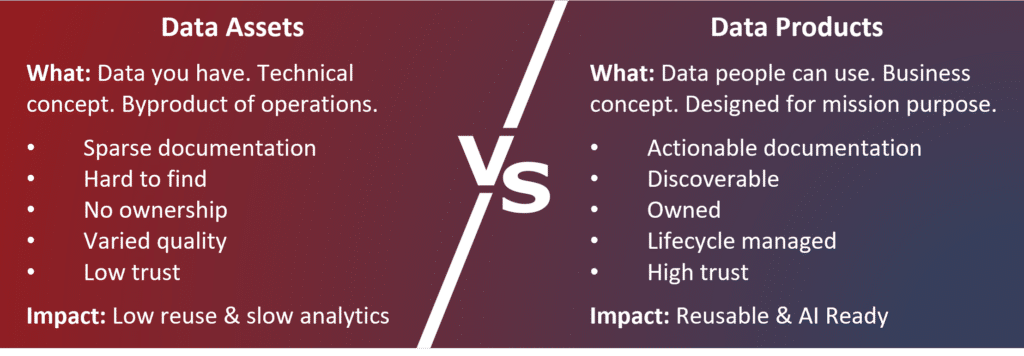
Not all data is created equal. Understanding the distinction between a data asset and a data product is where product thinking begins.
Think of it like the difference between a warehouse of raw ingredients and a grocery store shelf. Both have the same underlying inputs. Only one is ready to create value for the person who consumes it. When you take on the mindset of treating data as a product, the focus becomes mission aligned resulting in actionable data for your organization.
Product Thinking: The Framework Behind the Shift
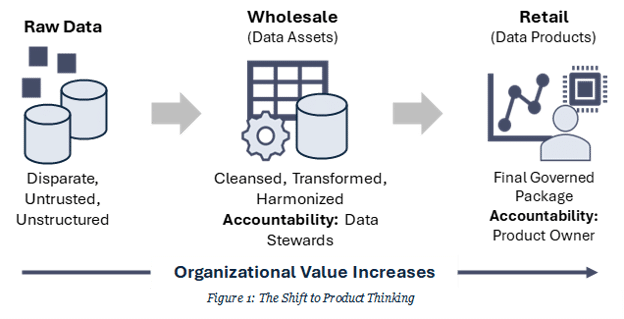
Applying product thinking to data means borrowing the discipline that makes great software successful and directing it to data assets with the same rigor. This requires clear ownership, user-centered design, quality standards, and a commitment to iterative improvement.
This spectrum is a useful mental model. Most agencies have plenty of data in the first two stages. The product thinking shift is about deliberately moving the most valuable data assets all the way to the right, where they are governed, accountable, ready to use, and discoverable.
Key Principles for Applying Product Thinking:
- Assign an owner. Every data product needs a named, accountable owner responsible for its quality, governance, and lifecycle.
- Design for the end user. High-value data products serve consumer needs — not the convenience of the systems that produce them.
- Prioritize usability. Data only drives impact when it’s used. Structure and delivery must center the consumer’s experience.
- Lead with mission value. Development should be prioritized based on what moves the needle most for the organization.
- Document the “why,” not just the “what.” Each product needs explicit use-cases so users understand its purpose, not just its contents.
- Publish a data contract. Define the product’s “interface” (schemas, semantics, SLAs/freshness expectations, quality checks, and versioning/change management) so downstream users can build with confidence.
- Make it discoverable. Once data is retail-ready, publish it to a data product marketplace so it reaches the widest possible audience.
- Measure results. Set goals and track for data consumption, accuracy, use cases satisfied, and other key metrics aligned to mission impact.
The Value of a Marketplace: Discoverability
If data products are the “retail-ready” items, the marketplace is the grocery store—the place people actually go to find what they need. A data product marketplace is a governed, searchable space where teams can find, understand, and request access to trusted data products. Instead of wandering the “warehouse” of systems, emailing stewards, or rebuilding datasets that already exist, analysts can browse what’s on the shelf, see what it’s for, and decide whether it fits their mission need. The payoff is simple: when products are easy to find, they get reused; when they’re hard to find, teams duplicate work or make decisions on partial context. Just like labels on products at a store, marketplace entries must communicate critical information to the consumers:
- A clear product name and mission-oriented description (what decisions it supports)
- A named owner and point of contact
- Definitions and key fields (so consumers interpret it the same way), backed by a published data contract when appropriate
- Lineage and source-of-truth notes (so it’s auditable)
- Quality signals (freshness, completeness, known caveats, and any standards/SLA) that align to the product’s data contract
- A straightforward access path (how to request, approvals required, and expected turnaround)
For federal agencies, a marketplace improves discovery, not open access. Users can see what a product is and how to request it, while access remains governed through need-to-know approvals and audit logging.
Leading organizations also treat the marketplace itself as a product. In grocery terms: someone owns the store experience: keeping categories sensible, improving search and “shelf labels,” and making sure what’s listed is accurate and up to date. Some agencies add AI-assisted discovery on top, like a knowledgeable clerk who can answer questions and point users to the right products with the context needed to use them correctly. That only works when products are consistently documented and governed, because the assistant can only reason over what’s clearly defined. For federal agencies, a well-run marketplace plus AI-assisted discovery is a practical way to scale analytics and AI while strengthening traceability and reuse.
Putting it into Practice: Unlocking the Impact of Federal Agencies’ Data
This is one of those ideas that sounds abstract until you see it working in the real world. We partner with multiple Federal Government Agencies to help modernize management and use of large data warehouses and analytic environments. The goal isn’t “more data.” It’s making the most valuable data easier to find, easier to understand, and easier to reuse, enabling teams to move faster with confidence.
| The Problem | The Opportunity |
|---|---|
|
|
One partner’s warehouse includes 74 distinct data assets. Before this effort, many of them were hard to discover across the environment, and the “so what?” (who uses this, for what decisions, and under what assumptions) wasn’t always captured in a consistent way. That’s a common pattern: smart analysts and engineers end up recreating datasets or re-learning the same context because the metadata, lineage, and usage guidance live in people’s heads—or scattered across documents. The result is slower delivery and more duplication than anyone wants.
We introduced a structured product-thinking approach to evaluate the data warehouse and quickly separate “data we have” from “data people can reliably use.” Out of the 74 assets, 25 have been identified as strong candidates to formalize as data products, and are being prioritized based on mission value and readiness. Here’s what the process looks like in plain terms:
- Identify existing data assets with data product potential
- Validate asset maturity against defined product traits: owner, lifecycle, quality standards, and documented use cases
- Define data lineage, tracing each product back to its authoritative parent sources
- Design user-centered product pages that make each data product understandable and searchable
- Publish products to the Data Product Marketplace, turning a static inventory into an interactive catalog
Even early on, the shift changes day-to-day work. Analysts can search and browse by mission use case instead of guessing table names. Lineage and “source of truth” notes are being captured in a way that’s visible to the next person who comes along. And because the marketplace makes existing products easier to spot, teams are reusing what’s already there rather than build something new. The first data asset the agency published as a product to the marketplace saw an immediate 50% increase in users accessing its metadata catalog per day. Data assets published to the marketplace see a daily average of 35% less support desk requests. For an agency where auditability is non-negotiable, having traceability baked in isn’t a nice-to-have—it’s the point.
The Real Prize: AI-Ready Data That Drives Mission Results
Data products are not the end goal. They are the foundation for something more powerful.
Federal agencies are under growing pressure to integrate AI into their operations, driven in part by direction like OMB Memo M-24-10 and the AI executive order EO 14110. But AI is only as good as the data it runs on. A model trained on inconsistent, undocumented, or duplicative data will produce unreliable outputs. In a federal context, that means denied benefits, missed threats, and misallocated resources. Getting data AI-ready is one of the most important and underestimated steps in any AI strategy.
Treating data as a product solves the AI readiness problem at the source. Properly governed, documented, and structured data products become reliable AI inputs. When they are discoverable through a marketplace, AI tools can find and consume them without manual data wrangling. Model outputs can be traced back to authoritative sources by including lineage documentation, making AI decisions explainable and auditable.
Analytica has designed and is currently implementing data product marketplaces for multiple clients ready to incorporate Generative AI capabilities that let users search for data products by use case in plain language. That capability would not be possible without the underlying structure of well-defined data products. This is the compounding power of product thinking: every improvement to the data layer unlocks new capabilities above it.
The broader benefits extend to the whole agency. Pre-packaged, clean data products dramatically cut the time analysts spend preparing data before they can use it. A discoverable marketplace prevents teams from duplicating work. Well-structured data products with clear schemas also become the building blocks for cross-agency data sharing, which is increasingly important as agencies face pressure to collaborate across organizational lines.
Treating data as a product isn’t just good practice — it’s how agencies get ahead of their compliance obligations. The Foundations for Evidence-Based Policymaking Act (P.L. 115-435) requires agencies to keep comprehensive data inventories and make assets discoverable and reusable. OMB M-19-18 pushes agencies toward consistent governance across the full data lifecycle, and OMB M-25-05 raises the bar even further by requiring standardized, catalog-ready inventories at scale. The bottom line is simple: without a data as a product framework, meeting these mandates is a manual, inconsistent process that is hard to defend under scrutiny. With this framework, every formalized data product becomes something you can point to as a usable asset, a compliance win, and the kind of trustworthy foundation that makes AI initiatives succeed.
Measuring What Matters
One hallmark of product thinking is accountability through measurement. Success of your data product strategy is measured by defining KPIs across six dimensions:
| Dimension | What It Measures | Target Metric |
|---|---|---|
| Adoption | Utilization of the data products marketplace | # of views |
| Awareness | Data products published to marketplace | # of published products |
| Speed | Time from data need to data discovery | % decrease |
| Actionability | Rate of product reuse across use cases | % increase |
| Quality | Consistent application of data standards | # of standards met |
| Traceability | Data lineage documented and accessible to users | # documented |
It is difficult to define and report the impact of how data management supports agency initiatives and mandates. These dimensions align measurable outputs of managing data as a product with organizational and mission goals of Federal Government agencies. Setting metric targets and tracking progress identifies where agencies should focus resources to create the largest impact with their data. Data contracts make these measures more actionable because expectations (definitions, schemas, and SLAs/quality checks) are explicit and can be validated over time. Understanding how their data is being used to serve the mission enables Federal Government agencies to know the true value.
The Time to Act Is Now
Agencies face a convergence of pressures: growing mission complexity, increasing public accountability, AI adoption mandates, and finite resources. The agencies that come out ahead will be the ones that stop treating data as a storage problem and start treating it as a product problem.
Product thinking is not a technology purchase. It is a discipline and a cultural commitment. But the agencies that make this shift do not just improve their data management. They build a foundation where powerful AI tools, advanced analytics, and cross-agency collaboration all become possible and sustainable.
Analytica is proud to be on that journey with our federal partners, helping agencies move from warehouses of untapped data assets to ecosystems of trusted, AI-ready data products that drive real mission impact.
We’re always happy to start with a conversation: what you’re trying to enable (analytics, governance, AI), what’s getting in the way, and where a data-product approach might create leverage.
From there, we can talk through practical options, timelines, and the contracting path that makes sense for your agency. If you’re exploring data modernization, governance, or AI readiness, let’s connect.
About Analytica
Analytica is a data and analytics consulting firm helping federal government agencies accelerate mission impact through data modernization, AI readiness, and product-driven approaches to data asset management.